T H Chang, T N Wang, H H Jen, and Y-C Chen
New J. Phys.
High-fidelity controlled-Z (CZ) gates are essential and mandatory to build a large-scale quantum computer. In neutral atoms, the strong dipole–dipole interactions between their Rydberg states make them one of the pioneering platforms to implement CZ gates. Here we numerically investigate the optimized pulses to generate a high-fidelity Rydberg CZ gate in a three-level ladder-type atomic system. By tuning the temporal shapes of Gaussian or segmented pulses, the populations on the intermediate excited states are shown to be suppressed within the symmetric gate operation protocol, which leads to a CZ gate with a high Bell fidelity up to 99.92%. These optimized pulses are robust to thermal fluctuations and the excitation field variations. Our results promise a high-fidelity and fast gate operation under amenable and controllable experimental parameters, which goes beyond the adiabatic operation regime under a finite blockade strength.
Chun-Che Wang, Yi-Cheng Wang, Chung-Hsien Wang, Chi-Chih Chen and H H Jen
New Journal of Physics
Cooling the trapped atoms toward their motional ground states is key to applications of quantum
simulation and quantum computation. By utilizing nonreciprocal couplings between two atoms,
we present an intriguing dark-state cooling scheme in Λ-type three-level structure, which is shown
superior than the conventional electromagnetically-induced-transparency cooling in a single atom.
The effective nonreciprocal couplings can be facilitated either by an atom–waveguide interface or a
free-space photonic quantum link. By tailoring system parameters allowed in dark-state cooling,
we identify the parameter regions of better cooling performance with an enhanced cooling rate.
We further demonstrate a mapping to the dark-state sideband cooling under asymmetric laser
driving fields, which shows a distinct heat transfer and promises an outperforming dark-state
sideband cooling assisted by collective spin–exchange interactions.
Yi-Cheng Wang, Jhih-Shih You & H. H. Jen
Nature Communications 13, 4598 (2022).
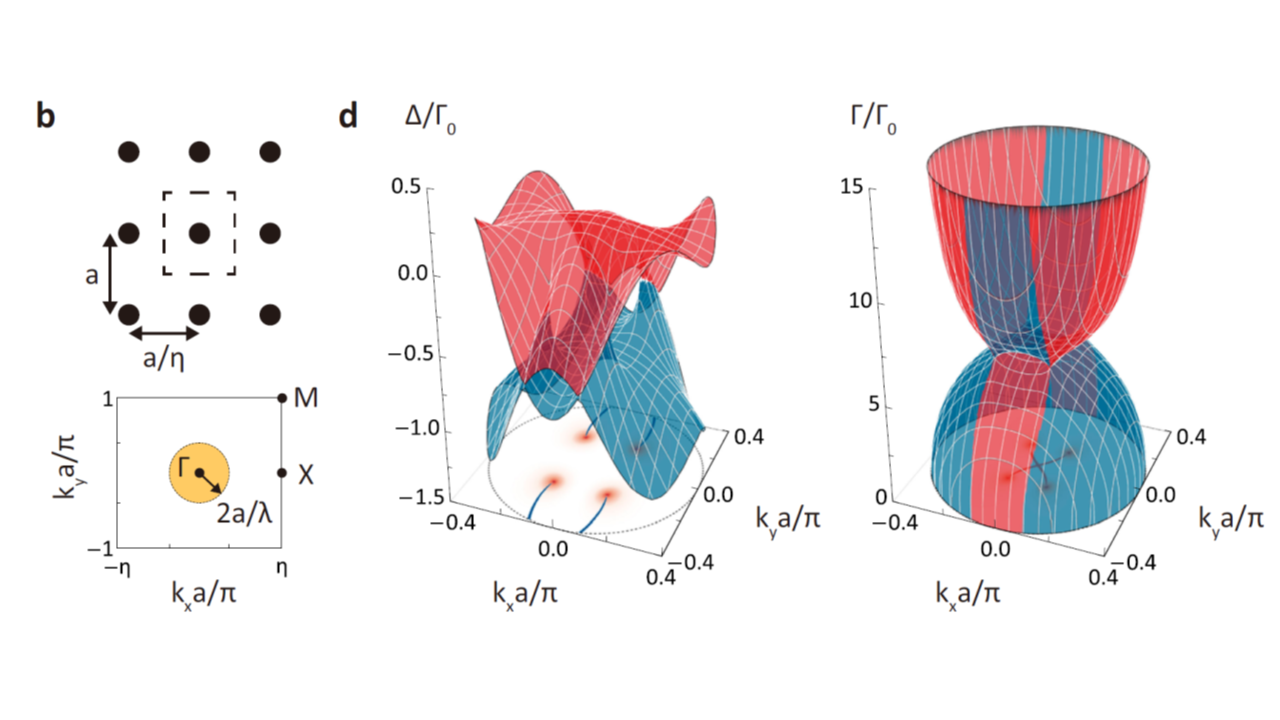
Explorations of symmetry and topology have led to important breakthroughs in quantum optics, but much richer behaviors arise from the non-Hermitian nature of light-matter interactions. A high-reflectivity, non-Hermitian optical mirror can be realized by a two-dimensional subwavelength array of neutral atoms near the cooperative resonance associated with the collective dipole modes. Here we show that exceptional points develop from a nondefective degeneracy by lowering the crystal symmetry of a square atomic lattice, and dispersive bulk Fermi arcs that originate from exceptional points are truncated by the light cone. From its nontrivial energy spectra topology, we demonstrate that the geometry-dependent non-Hermitian skin effect emerges in a ribbon geometry. Furthermore, skin modes localized at a boundary show a scale-free behavior that stems from the long-range interaction and whose mechanism goes beyond the framework of non-Bloch band theory. Our work opens the door to the study of the interplay among non-Hermiticity, topology, and long-range interaction.
H. H. Jen, G.-D. Lin, and Y.-C. Chen
Phys. Rev. A 105, 063711 (2022)
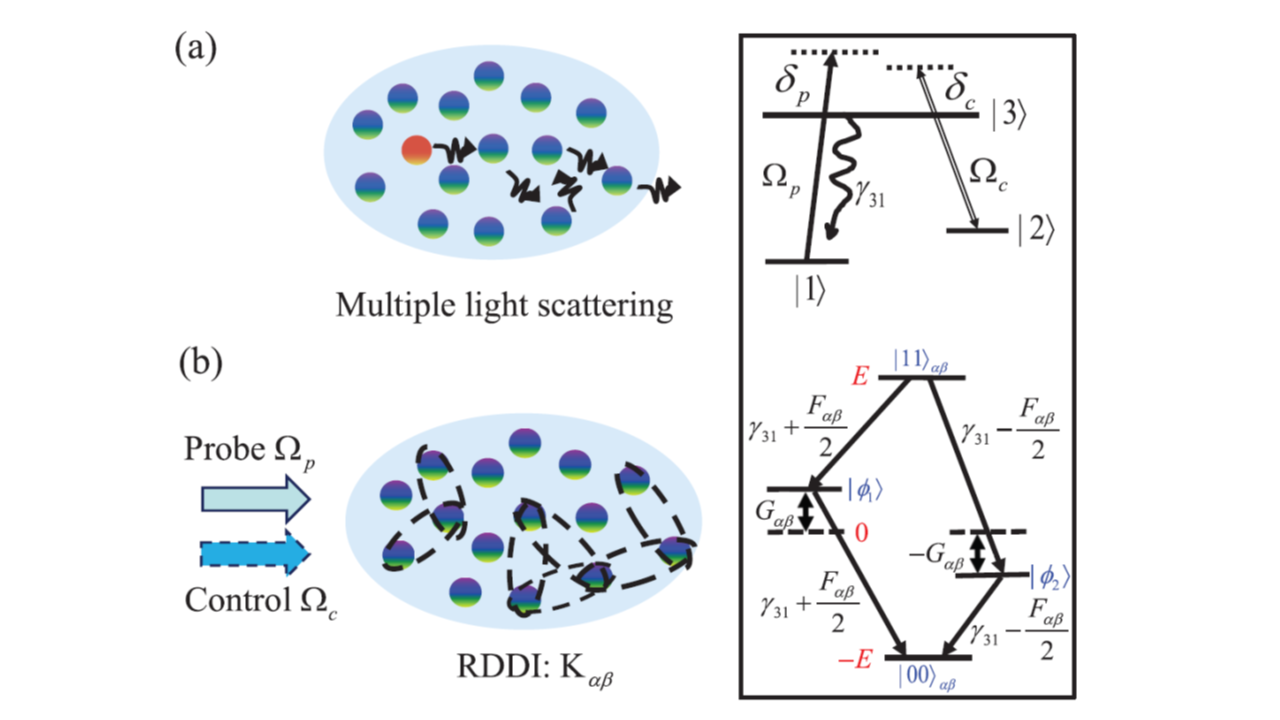
Resonant dipole-dipole interaction (RDDI) emerges in strong light-matter interacting systems, which leads to many fascinating phenomena such as cooperative light scattering and collective radiation. Here, we theoretically investigate the role of RDDI in electromagnetically induced transparency (EIT). The resonant dipole-dipole interactions manifest themselves in the cooperative spontaneous emission of the probe light transition, which give rise a broadened linewidth and associated collective frequency shift. This cooperative linewidth originates from the nonlocal and long-range RDDI, which can be determined by the atomic density, optical depth, and macroscopic length scales of the atomic ensemble. We present the finding that EIT spectroscopy essentially demonstrates all-order multiple scattering of RDDI. Furthermore, we find that the EIT transparency window becomes narrower as the cooperative linewidth increases, which essentially reduces the storage efficiency of slow light as an EIT-based quantum memory application.
H. H. Jen
Phys. Rev. A 105, 023717 (2022).
The atom-waveguide interface mediates significant and long-range light-matter interactions through guided modes. In this one-dimensional system, we theoretically investigate the excitation localization of multiple atomic excitations under strong position disorder. Deep in the localization side, we obtain the time evolutions of quantum correlations via Kubo cumulant expansions, which arise initially and become finite and leveled afterward, overtaking those without disorder. This indicates two distinct regimes in time: before the onset of excitation localization, the disorder engage the disturbance of quantum correlations, which is followed by disorder-assisted buildup of quantum correlations that maintain at a later stage owing to the absence of excitations diffusion. The crossing of distinct regimes is pushed further in time for longer-range correlations, which indicates a characteristic timescale needed for disorder to sustain them. We also explore the effect of directionality of couplings and resonant dipole-dipole interactions, which can drive the system toward the delocalized side when it is under chiral couplings or large dipole-dipole interaction strengths. The time-evolved quantum correlations can give insights into the studies of few-body localization phenomenon and nonequilibrium dynamics in open quantum systems.
H. H. Jen
Phys. Rev. A 103, 063711 (2021)
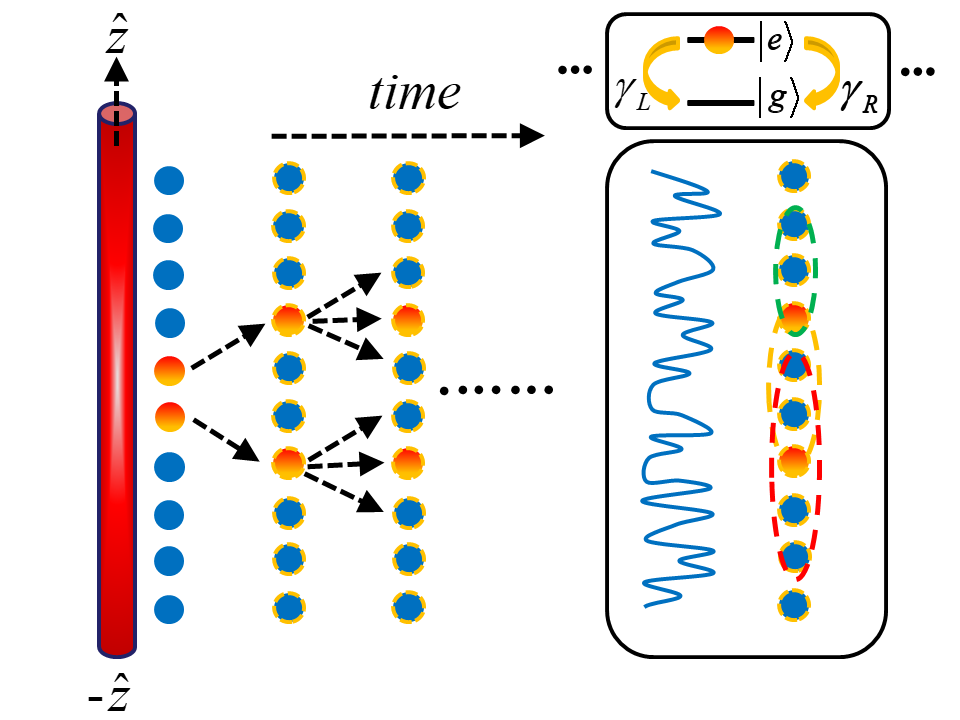
Collective decays of multiply excited atoms become subradiant and bound in space when they are strongly coupled to the guided modes in an atom-waveguide interface. In this interface, we analyze their average density-density and modified third-order correlations via Kubo cumulant expansions, which can arise, and finite correlations can be sustained for long time. The shape-preserving dimers and trimers of atomic excitations emerge in the most subradiant coupling regime of light-induced dipole-dipole interactions. This leads to a potential application of quantum information processing and quantum storage in the encoded nonreciprocal spin diffusion, where its diffusion speed depends on the initial coherence between the excited atoms and is robust to their relative phase fluctuations. The state-dependent photon routing can be viable as well in this interface.
 Institute of Atomic and Molecular Sciences Academia Sinica