S. Goswami, C. -H. Chien, N. Sinclair, B. Grinkemeyer, S. Bennetts, Y. -C. Chen, and H. H. Jen
Phys. Rev. Lett. 136, 050802 (2026).
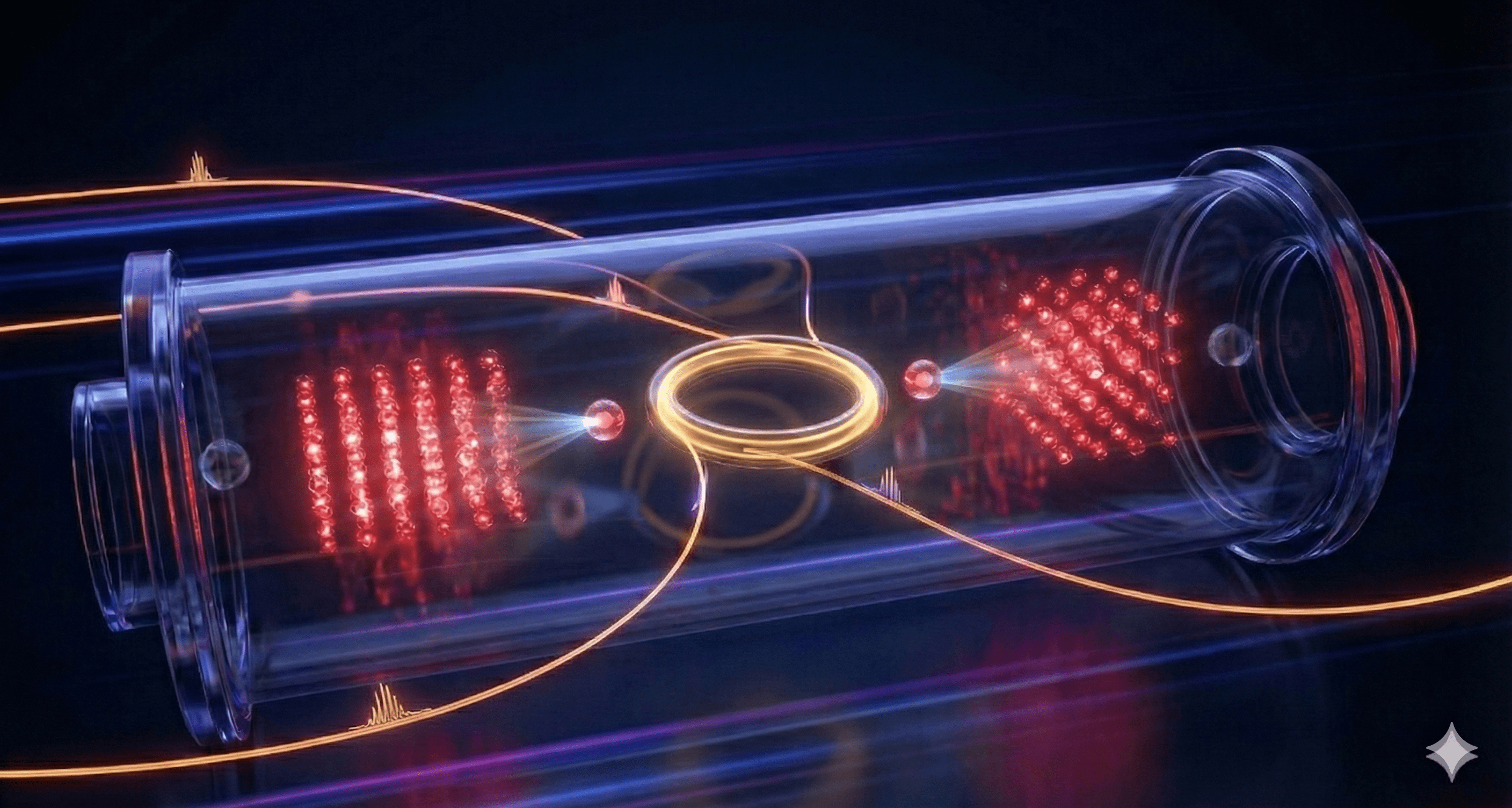
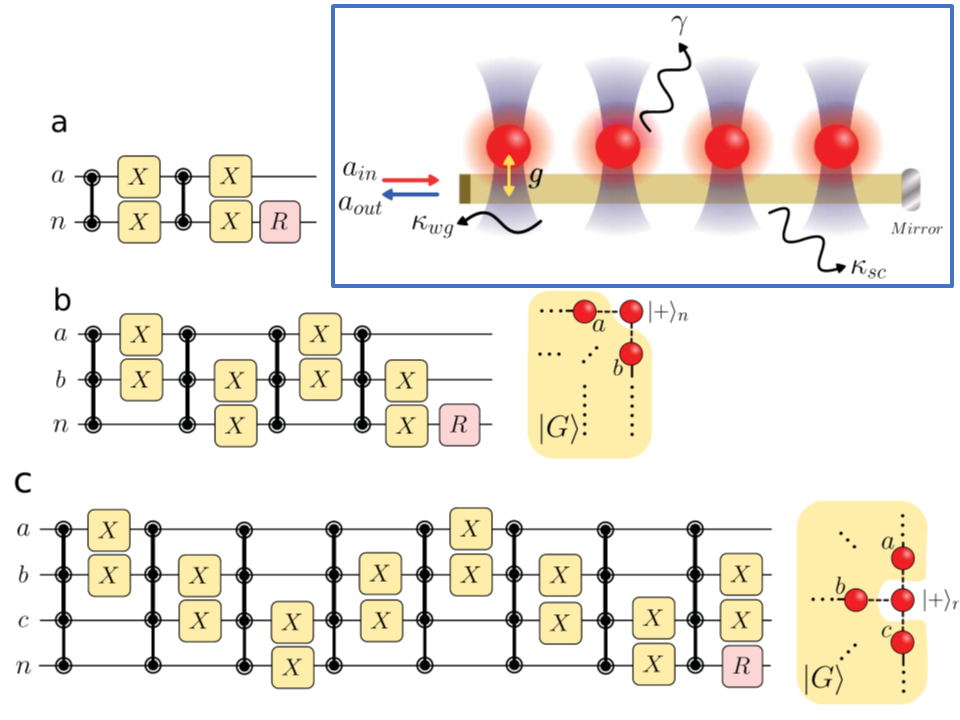
The so-called state-carving protocol generates high-fidelity entangled states at an atom-cavity interface without requiring high cavity cooperativity. However, this protocol is limited to 50% efficiency, which restricts its applicability. We propose a simple modification to the state-carving protocol to achieve efficient entanglement generation, with unit probability in principle. Unlike previous two-photon schemes, ours employs only one photon which interacts with the atoms twice - avoiding separate photon detections which causes irrecoverable probability loss. We present a detailed description and performance evaluation of our protocol under non-ideal conditions. High fidelity of 0.999 can be achieved with cavity cooperativity of only 34. Efficient state-carving paves the way for large-scale entanglement generation at cavity-interfaces for modular quantum computing, quantum repeaters and creating arbitrary shaped atomic graph states, essential for one-way quantum computing.
Sumit Goswami, Sayandip Dhara, Neil Sinclair, Makan Mohageg, Jasminder S. Sidhu, Sabyasachi Mukhopadhyay, Markus Krutzik, John R. Lowell, Daniel K. L. Oi, Mustafa Gündoğan, Ying-Cheng Chen, Hsiang-Hua Jen, and Christoph Simon
Optica Quantum 3, 590 (2025).

Academia, governments, and industry around the world are on a quest to build long-distance quantum communication networks for a future quantum internet. Using air and fiber channels, quantum communication quickly faced the daunting challenge of exponential photon loss with distance. Quantum repeaters were invented to solve the loss problem by probabilistically establishing entanglement over short distances and using quantum memories to synchronize the teleportation of such entanglement to long distances. However, due to imperfections and complexities of quantum memories, ground-based proof-of-concept repeater demonstrations have yet been restricted to metropolitan-scale distances. In contrast, direct photon transmission from satellites through empty space faces almost no exponential absorption loss and only quadratic beam divergence loss. A single satellite successfully distributed entanglement over more than 1,200 km. It is becoming increasingly clear that quantum communication over large intercontinental distances (e.g., 4,000–20,000 km) will likely employ a satellite-based architecture. This could involve quantum memories and repeater protocols in satellites, or memory-less satellite-chains through which photons are simply reflected, or some combination thereof. Rapid advancements in the space launch and classical satellite communications industry provide a strong tailwind for satellite quantum communication, promising economical and easier deployment of quantum communication satellites.
I Gusti Ngurah Yudi Handayana, Yi-Lin Tsao, and H. H. Jen
Phys. Rev. Research 7, 023303 (2025).
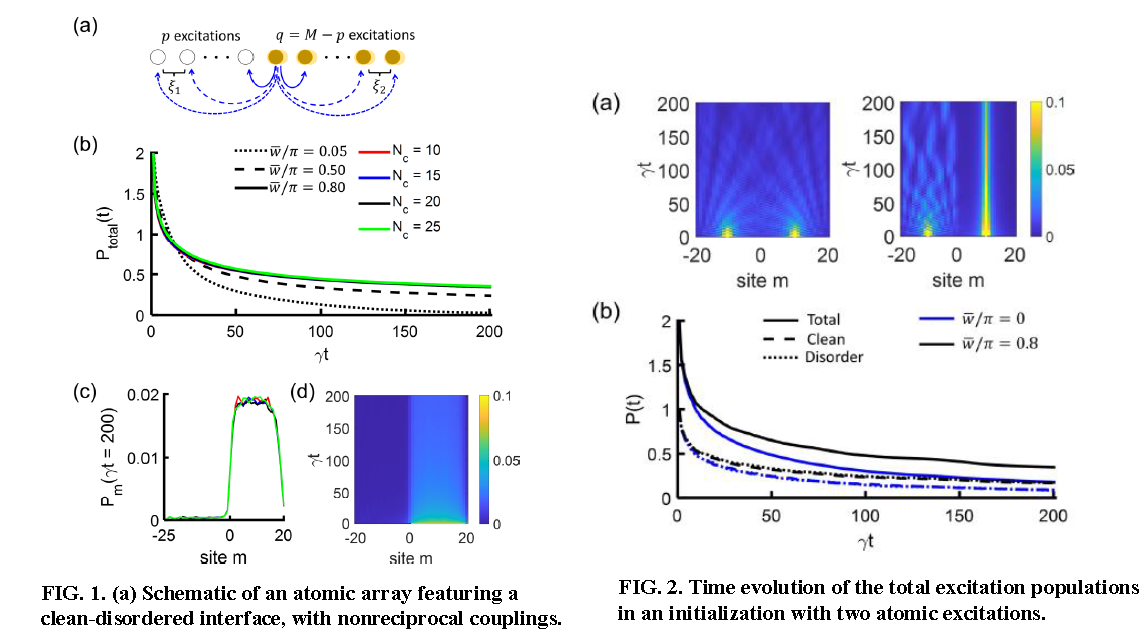
Quantum correlations are essential to the emergent behaviors of quantum systems, supporting key phenomena such as localization or delocalization of particles, quantum avalanches in many-body localized systems, and quantum information transfer. In open atom-nanophotonic systems characterized by long-range spin-exchange interactions, we examine the influence of clean system size on high-order quantum correlations among a clean-disordered atomic array with multiple atomic excitations. By initializing the system far from equilibrium, we observe a suppression of quantum correlations for localized atomic excitations in the disordered zone as the clean system size increases, showcasing the delocalization behavior in the high-order spin-exchange processes. The calculation of the entanglement entropy at the interface further substantiates this thermalizing effect. Our results manifest distinct quantum correlations enabled by long-range interactions mediated by the waveguide, enhance the theoretical comprehension of clean-disordered systems, and provide insights to nonequilibrium quantum dynamics in an atom-nanophotonic platform.
Chimdessa Gashu Feyisa, J-S You, Huan-Yu Ku and H H Jen
Quantum Sci. Technol. 10 025021 (2025).
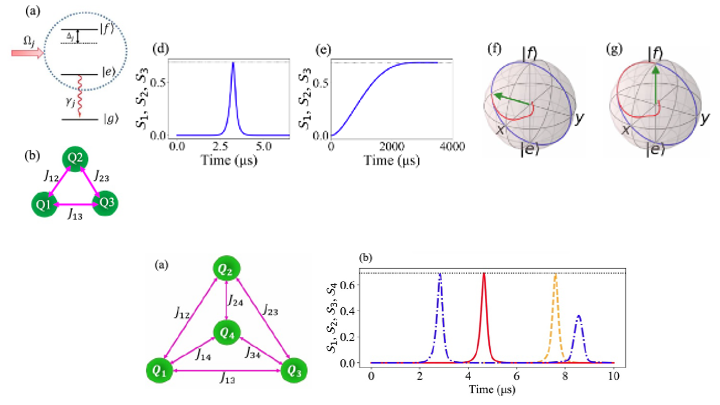
Open quantum systems are susceptible to losses in information, energy, and particles due to their surrounding environment. One novel strategy to mitigate these losses is to transform them into advantages for quantum technologies through tailored non-Hermitian quantum systems. In this work, we theoretically propose a fast generation of multipartite entanglement in non-Hermitian qubits. Our findings reveal that weakly coupled non-Hermitian qubits can accelerate multiparty entanglement generation by thousands of times compared to Hermitian qubits, in particular when approaching the 2^n-th order exceptional points of n qubits in the PT-symmetric regime. Furthermore, we show that Hermitian qubits can generate GHZ states with a high fidelity more than 0.9995 in a timescale comparable to that of non-Hermitian qubits, but at the expense of intense driving and large coupling constant. Our approach is scalable to a large number of qubits, presenting a promising pathway for advancing quantum technologies through the non-Hermiticity and higher-order exceptional points in many-body quantum systems.
C.-H. Chien, S. Goswami, C.-C. Wu, W.-S. Hiew, Y.-C. Chen, and H. H. Jen
Quantum Sci. Tech. 9, 025020 (2024).
Scalable graph states are essential for measurement-based quantum computation and many entanglement-assisted applications in quantum technologies. Generation of these multipartite entangled states requires a controllable and efficient quantum device with delicate design of generation protocol. Here we propose to prepare high-fidelity and scalable graph states in one and two dimensions, which can be tailored in an atom-nanophotonic cavity via state carving technique. We propose a systematic protocol to carve out unwanted state components, which facilitates scalable graph states generations via adiabatic transport of a definite number of atoms in optical tweezers. An analysis of state fidelity is also presented, and the state preparation probability can be optimized via multiqubit state carvings and sequential single-photon probes. Our results showcase the capability of an atom-nanophotonic interface for creating graph states and pave the way toward novel problem-specific applications using scalable high-dimensional graph states with stationary qubits.
C.-C. Wu, K.-T Lin, I G. N. Y. Handayana, C.-H. Chien, S. Goswami, G.-D. Lin, Y.-C. Chen, and H.
H. Jen
Phys. Rev. Research 6, 013159 (2024).
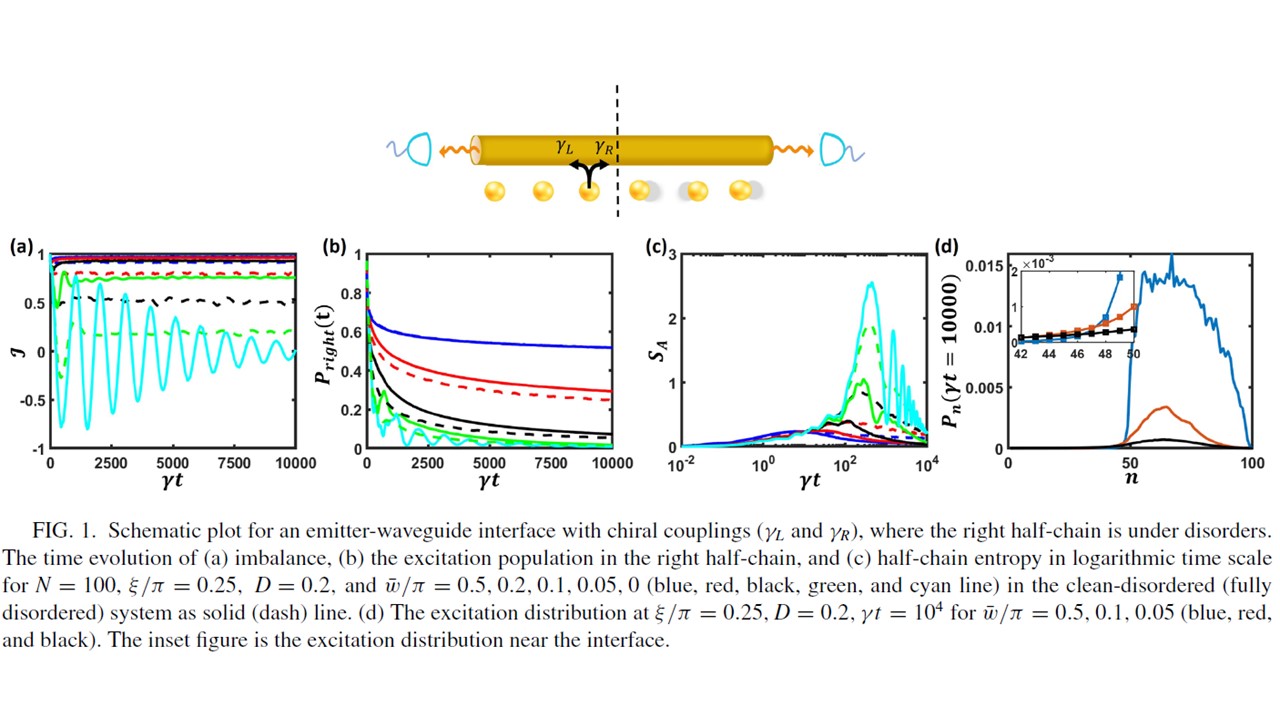
In one-dimensional quantum emitter systems, the dynamics of atomic excitations are influenced by the collective coupling between emitters through photon-mediated dipole-dipole interactions. By introducing positional disorders in a portion of the atomic array, we investigate the delocalization phenomena at the interface between the disordered and clean zones. The excitation is initialized as symmetric Dicke states in the disordered zone, and several measures are used to quantify the excitation localization. We first use population imbalance and half-chain entropy to investigate the excitation dynamics under time evolutions, and further investigate the crossover of excitation localization to delocalization via the gap ratio from the eigenspectrum in the reciprocal coupling case. In particular, we study the participation ratio of the whole chain and the photon loss ratio between both ends of the atomic chain, which can be used to quantify the delocalization crossover in the nonreciprocal coupling cases. Furthermore, by increasing the overall size or the ratio of the disordered zone under a fixed number of the whole chain, we observe that excitation localization occurs at a smaller disorder strength in the former case, while in the latter, facilitation of the delocalization appears when a significant ratio of the clean zone to disordered zone is applied. Our results can reveal the competition between the clean zone and the disordered zone sizes on localization phenomenon, give insights to nonequilibrium dynamics in the emitter-waveguide interface, and provide potential applications in quantum information processing.
 Institute of Atomic and Molecular Sciences Academia Sinica