Vortex Nucleations in Spinor Bose Condensates under Localized Synthetic Magnetic Fields
L.-R. Liu, S.-C. Wu1, T.-W. Liu, H.-Y. Hsu, T.-K. Shen, S.-K. Yip, Y. Kawaguchi, and Y.-J. Lin
Gauge fields are ubiquitous in modern quantum physics. In superfluids, quantized vortices can be induced by gauge fields. Here we demonstrate the first experimental observation of vortex nucleations in light-dressed spinor Bose-Einstein condensates under radially-localized synthetic magnetic fields. The light-induced spin-orbital-angular-momentum coupling creates azimuthal gauge potentials $\vec{A}$ for the lowest-energy spinor branch dressed eigenstate. The observation of the atomic wave function in the lowest-energy dressed eigenstate reveals that vortices nucleate from the cloud center of a vortex-free state with canonical momentum $\vec{p} = 0$. This is because a large circulating azimuthal velocity field ~$\vec{p}-\vec{A}$ at the condensate center results in a dynamically unstable localized excitation that initiates vortex nucleations. Our observation has reasonable agreement with the time-dependent Gross-Pitaevskii simulations.
Efficient and high-fidelity entanglement in cavity QED without high cooperativity
S. Goswami, C. -H. Chien, N. Sinclair, B. Grinkemeyer, S. Bennetts, Y. -C. Chen, and H. H. Jen
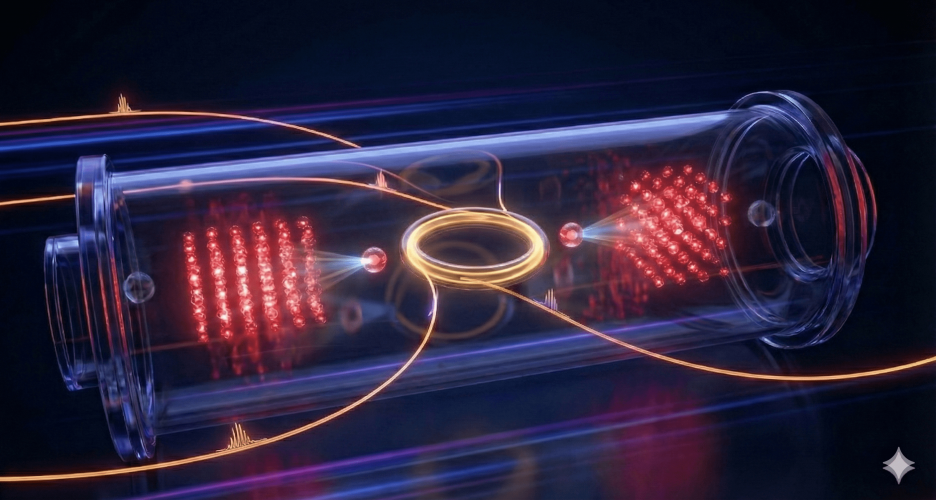
The so-called state-carving protocol generates high-fidelity entangled states at an atom-cavity interface without requiring high cavity cooperativity. However, this protocol is limited to 50% efficiency, which restricts its applicability. We propose a simple modification to the state-carving protocol to achieve efficient entanglement generation, with unit probability in principle. Unlike previous two-photon schemes, ours employs only one photon which interacts with the atoms twice - avoiding separate photon detections which causes irrecoverable probability loss. We present a detailed description and performance evaluation of our protocol under non-ideal conditions. High fidelity of 0.999 can be achieved with cavity cooperativity of only 34. Efficient state-carving paves the way for large-scale entanglement generation at cavity-interfaces for modular quantum computing, quantum repeaters and creating arbitrary shaped atomic graph states, essential for one-way quantum computing.
Sumit Goswami, Sayandip Dhara, Neil Sinclair, Makan Mohageg, Jasminder S. Sidhu, Sabyasachi Mukhopadhyay, Markus Krutzik, John R. Lowell, Daniel K. L. Oi, Mustafa Gündoğan, Ying-Cheng Chen, Hsiang-Hua Jen, and Christoph Simon
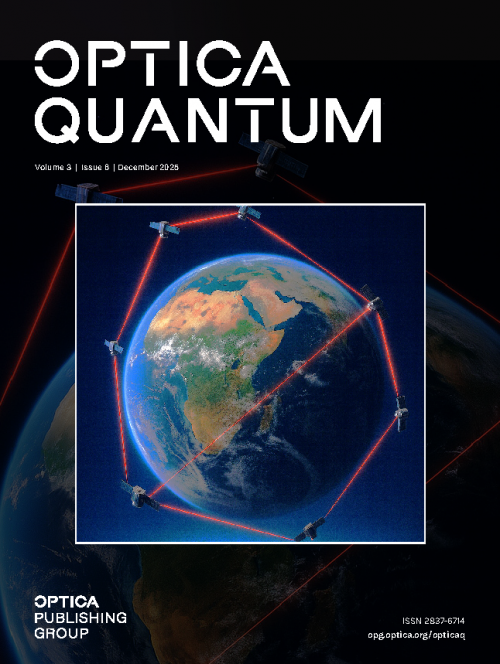
Academia, governments, and industry around the world are on a quest to build long-distance quantum communication networks for a future quantum internet. Using air and fiber channels, quantum communication quickly faced the daunting challenge of exponential photon loss with distance. Quantum repeaters were invented to solve the loss problem by probabilistically establishing entanglement over short distances and using quantum memories to synchronize the teleportation of such entanglement to long distances. However, due to imperfections and complexities of quantum memories, ground-based proof-of-concept repeater demonstrations have yet been restricted to metropolitan-scale distances. In contrast, direct photon transmission from satellites through empty space faces almost no exponential absorption loss and only quadratic beam divergence loss. A single satellite successfully distributed entanglement over more than 1,200 km. It is becoming increasingly clear that quantum communication over large intercontinental distances (e.g., 4,000–20,000 km) will likely employ a satellite-based architecture. This could involve quantum memories and repeater protocols in satellites, or memory-less satellite-chains through which photons are simply reflected, or some combination thereof. Rapid advancements in the space launch and classical satellite communications industry provide a strong tailwind for satellite quantum communication, promising economical and easier deployment of quantum communication satellites.
Ultrathin Fluorescent Nanodiamond Films for Nanoscale Quantum Sensing in Operando Semiconductor Devices
Yuen Yung Hui,1,* Yi-Mu Tsui,1,2 Yi-Xiu Tang,1 and Huan-Cheng Chang1,2,3,*
1Institute of Atomic and Molecular Sciences, Academia Sinica, Taipei 106, Taiwan 2Department of Chemistry, National Taiwan Normal University, Taipei 106, Taiwan 3Department of Chemical Engineering, National Taiwan University of Science and Technology, Taipei 106, Taiwan
Nanoscale quantum sensing is playing an increasingly critical role across diverse areas of research, particularly in the rapidly evolving field of semiconductor nanoelectronics. In this work, ultrathin fluorescent nanodiamond (FND) films are developed to function as quantum sensors for in operando measurements of magnetic fields and temperature in semiconductor devices. FNDs are electrically insulating carbon nanomaterials containing nitrogen-vacancy (NV) centers, renowned for their exceptional photostability and distinctive quantum properties. An electrospray deposition method is first established to produce uniform, near-monolayer FND films on bipolar junction transistors (BJTs) and field-effect transistors (FETs) without compromising their performance. Then, optically detected magnetic resonance (ODMR)s is employed to detect magnetic fields and monitor temperature increases as electrical currents are passed through the FND-coated semiconductor chips. Finally, we introduce a technique called FND-based lock-in photoluminescence (PL) thermography, which enables wide-field, real-time temperature sensing and imaging of these actively operating BJTs and FETs with nanometric spatial and millisecond temporal resolution. In comparison to ODMR, this innovative PL thermography method offers enhanced practicality and ease of implementation, making it well-suited for diagnostic applications in semiconductor devices.
Chemistry Meets Plasmon Polaritons and Cavity Photons: A Perspective from Macroscopic Quantum Electrodynamics
Liang-Yan Hsu*
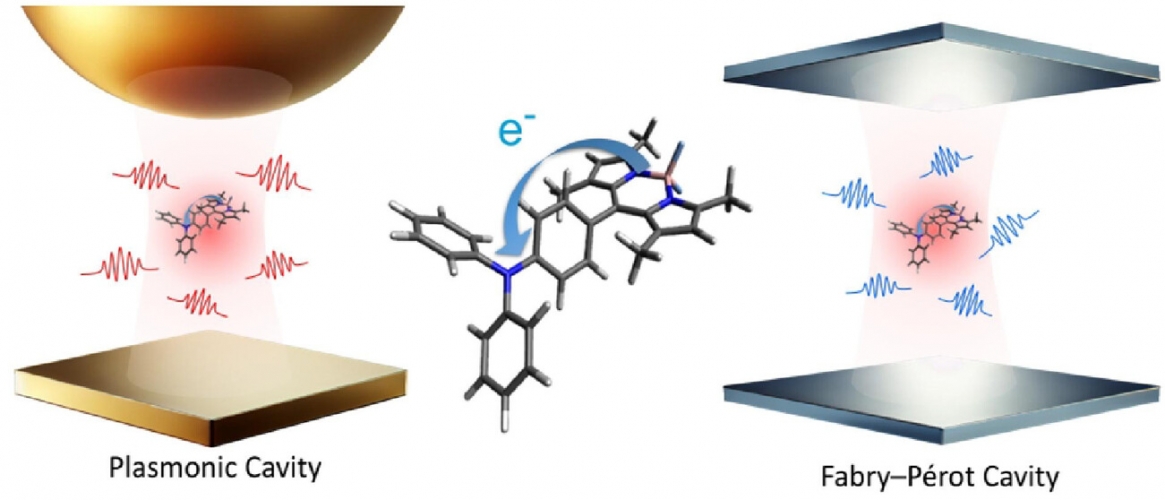
The interaction between light and molecules under quantum electrodynamics (QED) has long been less emphasized in physical chemistry, as semiclassical theories have dominated due to their relative simplicity. Recent experimental advances in polariton chemistry highlight the need for a theoretical framework that transcends traditional cavity QED and molecular QED models. Macroscopic QED is presented as a unified framework that seamlessly incorporates infinite photonic modes and dielectric environments, enabling applications to systems involving plasmon polaritons and cavity photons. This Perspective demonstrates the applicability of macroscopic QED to chemical phenomena through breakthroughs in molecular fluorescence, resonance energy transfer, and electron transfer. The macroscopic QED framework not only resolves the limitations of classical theories in physical chemistry but also achieves parameter-free predictions of experimental results, bridging quantum optics and material science. By addressing theoretical bottlenecks and unveiling new mechanisms, macroscopic QED establishes itself as an indispensable tool for studying QED effects on chemical systems.
Accelerating multipartite entanglement generation in non-Hermitian superconducting qubits
Chimdessa Gashu Feyisa, J-S You, Huan-Yu Ku and H H Jen
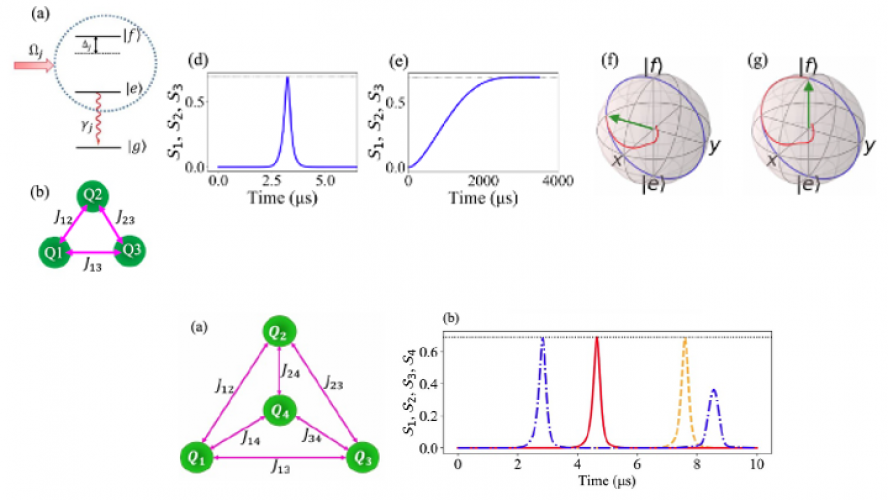
Open quantum systems are susceptible to losses in information, energy, and particles due to their surrounding environment. One novel strategy to mitigate these losses is to transform them into advantages for quantum technologies through tailored non-Hermitian quantum systems. In this work, we theoretically propose a fast generation of multipartite entanglement in non-Hermitian qubits. Our findings reveal that weakly coupled non-Hermitian qubits can accelerate multiparty entanglement generation by thousands of times compared to Hermitian qubits, in particular when approaching the 2^n-th order exceptional points of n qubits in the PT-symmetric regime. Furthermore, we show that Hermitian qubits can generate GHZ states with a high fidelity more than 0.9995 in a timescale comparable to that of non-Hermitian qubits, but at the expense of intense driving and large coupling constant. Our approach is scalable to a large number of qubits, presenting a promising pathway for advancing quantum technologies through the non-Hermiticity and higher-order exceptional points in many-body quantum systems.
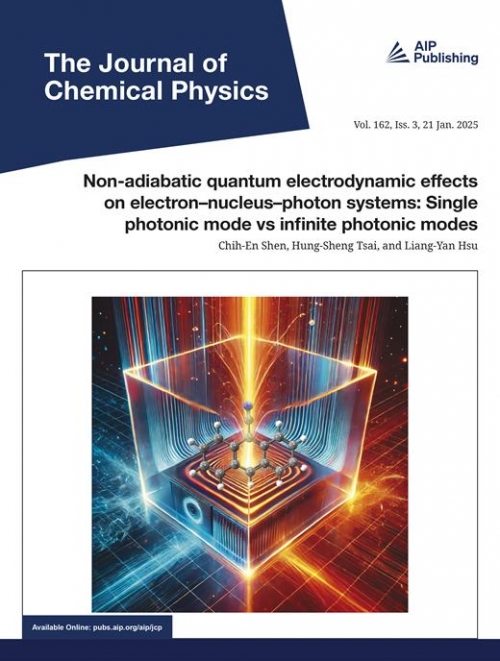
Non-Adiabatic Quantum Electrodynamic Effects on Electron–Nucleus–Photon Systems: Single Photonic Mode vs Infinite Photonic Modes [Feature Article]
Chih-En Shen, Hung-Sheng Tsai, Liang-Yan Hsu*
The quantum-electrodynamic non-adiabatic emission (QED-NAE) is a type of radiatively assisted vibronic de-excitation due to electromagnetic vacuum fluctuations on non-adiabatic processes. Building on our previous work [Tsai et al., J. Phys. Chem. Lett. 14, 5924 (2023)], we extend the theory of the QED-NAE rate from a single cavity photonic mode to infinite photonic modes and calculate the QED-NAE rates of 9-cyanoanthracene at the first-principles level. To avoid the confusion, the quantum electrodynamic internal conversion process is renamed as “QED-NAE” in our present work. According to our theory, we identify three key factors influencing the QED-NAE processes: light–matter coupling strength (mode volume), mass-weighted orientation factor, and photonic density of states. The mode volume is the primary factor causing rate differences between the two scenarios. In a single cavity with a small mode volume, strong light–matter coupling strength boosts QED-NAE rates. In contrast, in free space with infinite photonic modes, weak coupling strength significantly reduces these rates. From a single cavity photonic mode to infinite photonic modes, the mass-weighted orientation factor only causes an 8π/3-fold increase in the QED-NAE rate. In free space, the photonic density of state exhibits a flat and quadratic distribution, which slightly reduces the QED-NAE rate. Our study shows that cavities can significantly enhance non-adiabatic QED effects while providing a robust analysis demonstrating that QED vibronic effects can be safely ignored in free space.
Point Spread Function Engineering for Spiral Phase Interferometric Scattering Microscopy Enables Robust 3D Single-Particle Tracking and Characterization
Nathan J. Brooks, Chih-Chen Liu, Yan-Hsien Chen, and Chia-Lung Hsieh*
Interferometric scattering (iSCAT) microscopy is currently among the most powerful techniques available for achieving high-sensitivity single-particle localization. This capability is realized through homodyne detection, where interference with a reference wave offers the promise of exceptionally precise three-dimensional (3D) localization. However, the practical application of iSCAT to 3D tracking has been hampered by rapid oscillations in the signal-to-noise ratio (SNR) as particles move along the axial direction. In this study, we introduce a novel strategy based on back pupil plane engineering, wherein a spiral phase mask is used to redistribute the phase of the scattered field of the particle uniformly across phase space, thus ensuring consistent SNR as the particle moves throughout the focal volume. Our findings demonstrate that this modified spiral phase iSCAT exhibits greatly enhanced localizability characteristics. Additionally, the uniform phase distribution enables reliable characterization of the particle’s optical properties regardless of its position. We substantiate our theoretical results with numerical and experimental demonstrations, showcasing the practical application of this approach for high-precision, ultrahigh-speed (20,000 frames per second) 3D tracking and polarizability measurement of freely diffusing nanoparticles as small as 20 nm.
Te-I Liu*, Jhih-Shan Wang, Ai-Phuong Nguyen, Marco Raabe, Carlos Jose Quiroz Reyes, Chih-Hsin Lin, Ching-Wei Lin*
Cytometry plays a crucial role in characterizing cell properties, but its restricted optical window (400-850 nm) limits the number of stained fluorophores that can be detected simultaneously and hampers the study and utilization of short-wave infrared (SWIR; 900-1,700 nm) fluorophores in cells. Here we introduce two SWIR-based methods to address these limitations: SWIR flow cytometry and SWIR image cytometry. We develop a quantification protocol for deducing cellular fluorophore mass. Both systems achieve a limit of detection of ~0.1 fg cell−1 within a 30-min experimental timeframe, using individualized, high-purity (6,5) single-wall carbon nanotubes as a model fluorophore and macrophage-like RAW264.7 as a model cell line. This high-sensitivity feature reveals that low-dose (6,5) serves as an antioxidant, and cell morphology and oxidative stress dose-dependently correlate with (6,5) uptake. Our SWIR cytometry holds immediate applicability for existing SWIR fluorophores and offers a solution to the issue of spectral overlapping in conventional cytometry.
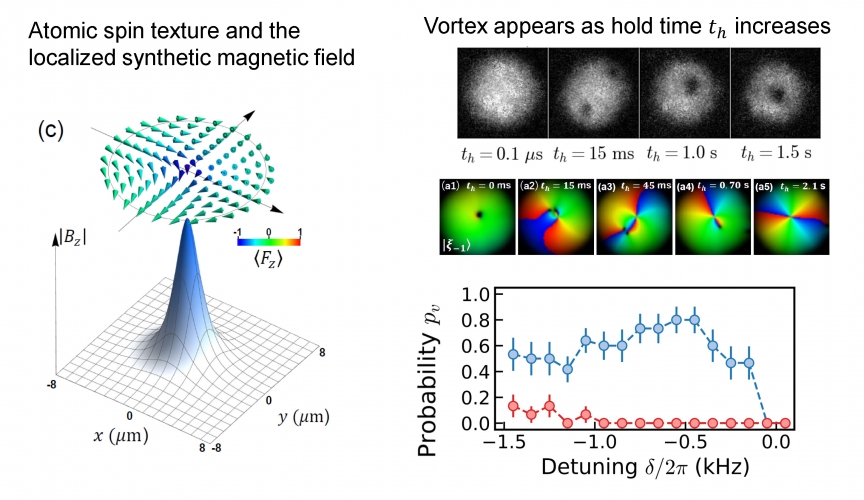 Gauge fields are ubiquitous in modern quantum physics. In superfluids, quantized vortices can be induced by gauge fields. Here we demonstrate the first experimental observation of vortex nucleations in light-dressed spinor Bose-Einstein condensates under radially-localized synthetic magnetic fields. The light-induced spin-orbital-angular-momentum coupling creates azimuthal gauge potentials $\vec{A}$ for the lowest-energy spinor branch dressed eigenstate. The observation of the atomic wave function in the lowest-energy dressed eigenstate reveals that vortices nucleate from the cloud center of a vortex-free state with canonical momentum $\vec{p} = 0$. This is because a large circulating azimuthal velocity field ~$\vec{p}-\vec{A}$ at the condensate center results in a dynamically unstable localized excitation that initiates vortex nucleations. Our observation has reasonable agreement with the time-dependent Gross-Pitaevskii simulations.