中央研究院 原子與分子科學研究所
重要研究成果
第 1 頁
第 2 頁
許良彥 博士
(2025)
J. Phys. Chem. Lett., 16, 1604−1619 (2025).
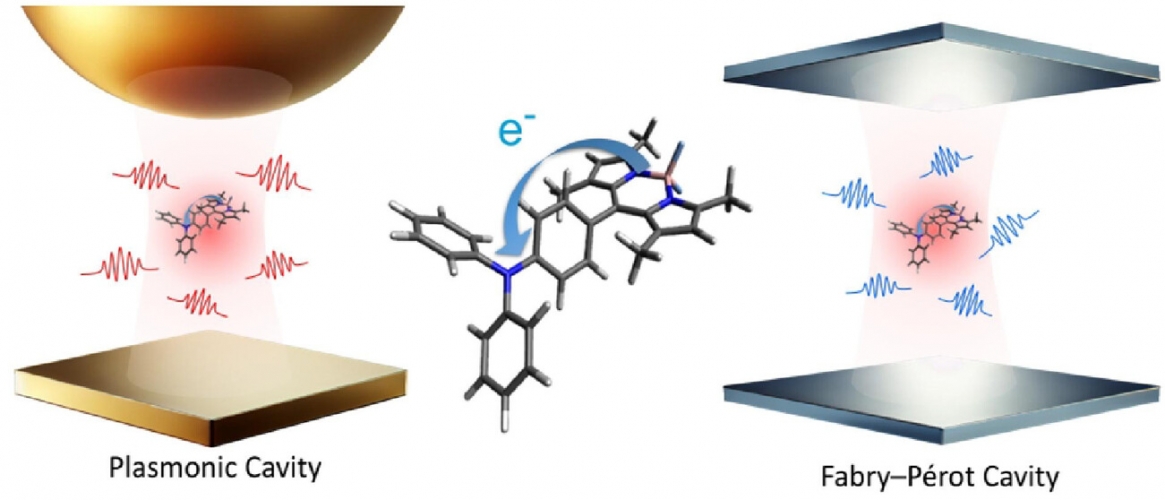
The interaction between light and molecules under quantum electrodynamics (QED) has long been less emphasized in physical chemistry, as semiclassical theories have dominated due to their relative simplicity. Recent experimental advances in polariton chemistry highlight the need for a theoretical framework that transcends traditional cavity QED and molecular QED models. Macroscopic QED is presented as a unified framework that seamlessly incorporates infinite photonic modes and dielectric environments, enabling applications to systems involving plasmon polaritons and cavity photons. This Perspective demonstrates the applicability of macroscopic QED to chemical phenomena through breakthroughs in molecular fluorescence, resonance energy transfer, and electron transfer. The macroscopic QED framework not only resolves the limitations of classical theories in physical chemistry but also achieves parameter-free predictions of experimental results, bridging quantum optics and material science. By addressing theoretical bottlenecks and unveiling new mechanisms, macroscopic QED establishes itself as an indispensable tool for studying QED effects on chemical systems.
任祥華 博士
(2025)
Quantum Sci. Technol. 10 025021 (2025).
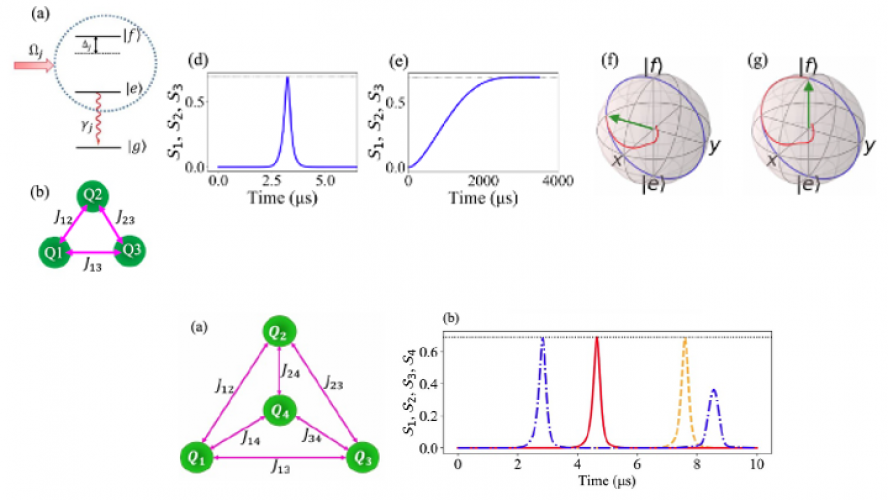
Open quantum systems are susceptible to losses in information, energy, and particles due to their surrounding environment. One novel strategy to mitigate these losses is to transform them into advantages for quantum technologies through tailored non-Hermitian quantum systems. In this work, we theoretically propose a fast generation of multipartite entanglement in non-Hermitian qubits. Our findings reveal that weakly coupled non-Hermitian qubits can accelerate multiparty entanglement generation by thousands of times compared to Hermitian qubits, in particular when approaching the 2^n-th order exceptional points of n qubits in the PT-symmetric regime. Furthermore, we show that Hermitian qubits can generate GHZ states with a high fidelity more than 0.9995 in a timescale comparable to that of non-Hermitian qubits, but at the expense of intense driving and large coupling constant. Our approach is scalable to a large number of qubits, presenting a promising pathway for advancing quantum technologies through the non-Hermiticity and higher-order exceptional points in many-body quantum systems.
謝佳龍 博士
(2024)
ACS Photonics 11(12), 5239–5250 (2024)
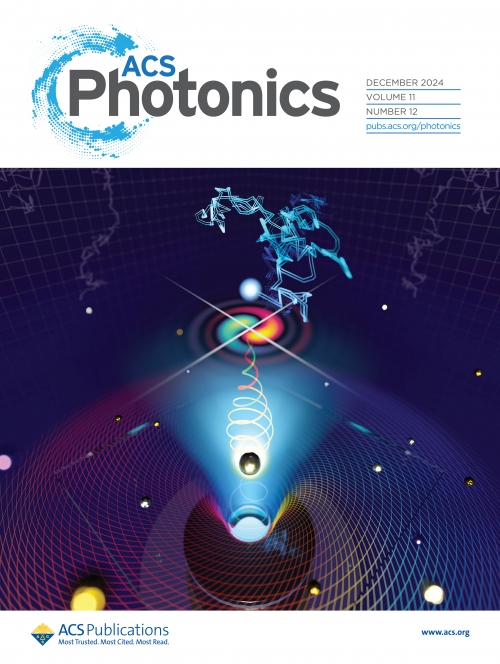
Interferometric scattering (iSCAT) microscopy is currently among the most powerful techniques available for achieving high-sensitivity single-particle localization. This capability is realized through homodyne detection, where interference with a reference wave offers the promise of exceptionally precise three-dimensional (3D) localization. However, the practical application of iSCAT to 3D tracking has been hampered by rapid oscillations in the signal-to-noise ratio (SNR) as particles move along the axial direction. In this study, we introduce a novel strategy based on back pupil plane engineering, wherein a spiral phase mask is used to redistribute the phase of the scattered field of the particle uniformly across phase space, thus ensuring consistent SNR as the particle moves throughout the focal volume. Our findings demonstrate that this modified spiral phase iSCAT exhibits greatly enhanced localizability characteristics. Additionally, the uniform phase distribution enables reliable characterization of the particle’s optical properties regardless of its position. We substantiate our theoretical results with numerical and experimental demonstrations, showcasing the practical application of this approach for high-precision, ultrahigh-speed (20,000 frames per second) 3D tracking and polarizability measurement of freely diffusing nanoparticles as small as 20 nm.
林靖衛 博士
(2024)
ACS Nano 18, 18534–18547 (2024).
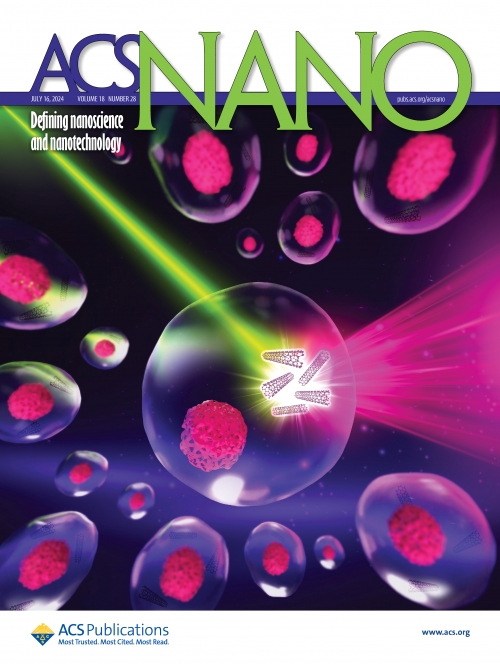
Cytometry plays a crucial role in characterizing cell properties, but its restricted optical window (400-850 nm) limits the number of stained fluorophores that can be detected simultaneously and hampers the study and utilization of short-wave infrared (SWIR; 900-1,700 nm) fluorophores in cells. Here we introduce two SWIR-based methods to address these limitations: SWIR flow cytometry and SWIR image cytometry. We develop a quantification protocol for deducing cellular fluorophore mass. Both systems achieve a limit of detection of ~0.1 fg cell−1 within a 30-min experimental timeframe, using individualized, high-purity (6,5) single-wall carbon nanotubes as a model fluorophore and macrophage-like RAW264.7 as a model cell line. This high-sensitivity feature reveals that low-dose (6,5) serves as an antioxidant, and cell morphology and oxidative stress dose-dependently correlate with (6,5) uptake. Our SWIR cytometry holds immediate applicability for existing SWIR fluorophores and offers a solution to the issue of spectral overlapping in conventional cytometry.
目前位置:關於本所 / 重要研究成果 / 第 2 頁

中央研究院 原子與分子科學研究所版權所有 |
使用者條款、資訊安全與隱私權政策 |
保有個資檔案公開項目彙整表 |
行動版
地址: 106319 台北市羅斯福路四段一號 或 106923 臺北臺大郵局 第23-166號信箱
電話:886-2-2362-0212 傳真:886-2-2362-0200 電子郵件:iamspublic@gate.sinica.edu.tw
最後更新於 2026-06-18 16:16:35
地址: 106319 台北市羅斯福路四段一號 或 106923 臺北臺大郵局 第23-166號信箱
電話:886-2-2362-0212 傳真:886-2-2362-0200 電子郵件:iamspublic@gate.sinica.edu.tw
最後更新於 2026-06-18 16:16:35