中央研究院 原子與分子科學研究所
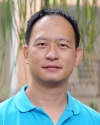
任祥華 博士 (原子物理與光學組)


最新研究成果
S. Goswami, C. -H. Chien, N. Sinclair, B. Grinkemeyer, S. Bennetts, Y. -C. Chen, and H. H. Jen
Phys. Rev. Lett. 136, 050802 (2026).
The so-called state-carving protocol generates high-fidelity entangled states at an atom-cavity interface without requiring high cavity cooperativity. However, this protocol is limited to 50% efficiency, which restricts its applicability. We propose a simple modification to the state-carving protocol to achieve efficient entanglement generation, with unit probability in principle. Unlike previous two-photon schemes, ours employs only one photon which interacts with the atoms twice - avoiding separate photon detections which causes irrecoverable probability loss. We present a detailed description and performance evaluation of our protocol under non-ideal conditions. High fidelity of 0.999 can be achieved with cavity cooperativity of only 34. Efficient state-carving paves the way for large-scale entanglement generation at cavity-interfaces for modular quantum computing, quantum repeaters and creating arbitrary shaped atomic graph states, essential for one-way quantum computing.
目前位置:本所人員 / 研究人員/ 任祥華

中央研究院 原子與分子科學研究所版權所有 |
使用者條款、資訊安全與隱私權政策 |
保有個資檔案公開項目彙整表 |
行動版
地址: 106319 台北市羅斯福路四段一號 或 106923 臺北臺大郵局 第23-166號信箱
電話:886-2-2362-0212 傳真:886-2-2362-0200 電子郵件:iamspublic@gate.sinica.edu.tw
最後更新於 2026-05-14 13:43:10
地址: 106319 台北市羅斯福路四段一號 或 106923 臺北臺大郵局 第23-166號信箱
電話:886-2-2362-0212 傳真:886-2-2362-0200 電子郵件:iamspublic@gate.sinica.edu.tw
最後更新於 2026-05-14 13:43:10